
The secret behind this painting and why there is still hope for Europe
For two decades, it had been believed the painting was about losing young men’s soul to Satan, until a chess master looked at it.
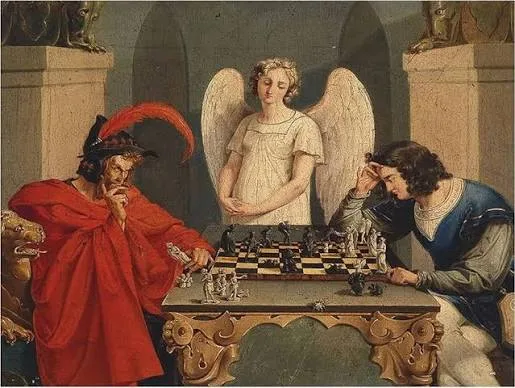
In 1831, German artist Friedrich Moritz August Retzsch finished what would arguably become his most famous work which later gained the name “The Devil’s Checkmate”.
The painting depicts a game of chess. On one side is Satan,arrogant and utterly confident in his victory. On the other side sits a young man in despair, staring at the pieces as though he has just been checkmated. Between them stands a saddened angel whose expression confirms to anyone looking at the painting that the young man has indeed lost his wager.
Not just any wager, but a wager for his soul.
For decades, it was assumed that the young man had lost this chess game. Until the story about Paul Morphy was born.
Legendary story
Paul Morphy, chess prodigy, a player so dominant he retired from competitive chess in his twenties. In the 1850s, Morphy was invited to see the painting by his companion to look at the painting. No chess player ever inspected the play itself as it was widely known that the young man lost. But not Morphy, he didn't just glance and move on. He just stood there, carefully studying the play for a long stretch of time. Eventually he announced something startling: “The title was wrong”. According to Morphy, the young man has not been beaten, his king had one saving move that would flip the outcome and let him win the game.
Alternative version
In 1888 Columbia Chess Chronicle printed an account that tells the story a little differently. In that version, Morphy encounters a copy of the painting while visiting a home in Richmond Virginia. After taking a look at the painting, someone in the room announces that not even Morphy could rescue the young man. To this dare Morphy simply replied: “Suppose we place the men and try.”.
They set up chess pieces to mirror the painted position and Morphy proceeded to work it out on the physical board. This account suggests the young man needed more than just one miracle move to actually escape which makes it more believable than “one brilliant move solves it all” story.
How this concludes there is still hope for Europe
In the end, it doesn't matter which story is true. What matters is the message of the story. The message that assures us that there is still one more move left. Even when defeat appears certain, the game may not be over.
As Europe is currently facing an existence crisis, this story and painting reminds us that we haven't been defeated yet, whether it's one miracle move or a set of multiple moves. We may find ourselves in a difficult position, surrounded by problems that seem impossible to overcome . But being in a difficult position is not the same as being defeated.
When Vienna was besieged by the Ottoman army in 1683, the defenders of the city were facing an increasingly desperate situation. After weeks of resistance a large relief army led by Polish King John III Sobieski arrived, defeated the Ottoman army and saved Vienna..
“Venimus, vidimus, Deus vicit.” (“We came, we saw, God conquered.”) - King John Sobieski III
The lesson is not that Europe will always be saved by a miracle. It is that the outcome is not necessarily decided simply because the position looks hopeless.
We still have a move to make.